QUASI CONTRACTS

 QUASI CONTRACTS

There are situations where even in absence of contract, certain social relationships result in specific obligation towards specific person. They are not contracts because parties have no prior consensus. But the facts of the circumstances are such that a similar relation is presumed. These are known as quasi contracts.

Quasi contracts are based on principles of equity, justice and good conscience. They are based on the equitable principle that a person shall not be allowed to enrich himself at the expense of another. They are not from the agreement but are imposed by the law for an orderly and just society. These are neither torts as here the obligation is towards specific person.

Law enumerates following five circumstances as quasi-contracts –

(a) Claim for necessaries supplied to persons incapable of contracting

  • Person incapable of entering into contract, such as minor or lunatic
  • He or his dependents are supplied with
  • Necessaries suited to his condition in life
  • Person supplying such necessaries is entitled to claim the price from the person’s property.

For example, A supplies B, a lunatic or B’s wife or child, with necessaries suitable to their condition in life. A is entitled to be reimbursed from B’s property.

It is important that the supplies are limited to necessaries and no claim for luxury articles can be made.

(b) Reimbursement of money paid due to another

A person who has paid a sum of money which another is obliged to pay, is entitled to be reimbursed by that other person provided the payment has been made by him to protect his own interest.

For example, B holds land in Bengal, on a lease granted by A, the zamindar. The revenue payable by A to the Government being in arrear, his land is advertised for sale by the Government. Under the revenue law, the consequence of such sale will be the annulment of B’s lease. B, to prevent the sale and the consequent annulment of his own lease, pays to the Government the sum due from A. A is bound to make good to B the amount so paid.

(c) Obligation of person enjoying benefits of non-gratuitous act

  • Person lawfully does or delivers anything to another
  • Not intending to do so gratuitously
  • Such other person enjoys the benefit thereof
  • The latter is bound to restore the thing or make compensation to the former.

For example, A, a trader, leaves goods at B’s house by mistake. B treats the goods as his own. He is bound to pay A for them.

(d) Responsibility of finder of goods

A person who finds goods belonging to another and takes them into his custody, is subject to the same responsibility as a bailee. Thus, his duties are –

  1. Take proper care of the property as man of ordinary prudence would take
  2. Not to appropriate the goods
  3. Restore the goods to its owner, if the owner is found.

For example, A, a shop owner, finds a gold ear ring in his shop. He has CCTVs installed in his shop, but he does not care to examine the footage. Nor keep it in safe, as the item requires. But keeps it on his desk, from where it goes missing. A is liable to compensate the owner of the ear ring for the loss.

It is important to note that the finder of goods can claim reimbursement for expenditure incurred for preserving the goods and in searching the true owner. He may also claim any award, if announced by the owner. If the real owner refuses to pay the compensation or the award, the finder can exercise his right of lien, that is, refuse to deliver the article.

Finder of goods may also sell the goods under certain conditions.

  1. When a thing which is commonly the subject of sale is lost,
  2. If the owner cannot with reasonable diligence be found, or
  3. If he refuses, upon demand, to pay the lawful charges of the finder,

The finder may sell it –

  1. when the thing is in danger of perishing or of losing the greater part of its value, or,
  2. when the lawful charges of the finder, in respect of the thing found, amount to two-thirds of its value.

(e) Liability for money paid or thing delivered by mistake or by coercion

A person to whom money has been paid, or anything delivered, by mistake or under coercion, must repay or return it.

For example, A orders a pizza over a phone call. The delivery boy mistakenly delivers it to B. B eats the pizza. B is bound to pay the price of the pizza.

In all the above cases the contractual liability arises without any agreement between the parties.

Law of Contract – Breach of Contract

 BREACH OF CONTRACT

Breach means breaking of the rules. In respect of contract, breach means failure to perform what is required under the contract. Breach of contract is of two types – Anticipatory and Actual.

Anticipatory Breach of Contract

Where the promisor refuses to perform his obligation even before the specified time for performance and signifies his unwillingness, then there is an anticipatory breach.

For example, A engages services of B as his attendant for a 3 months tour at Rs. 5000/- per month starting from 1st June. However, A changes his mind before the date and informs B that his services are not required. This is anticipatory breach of contract.

In such cases, B may put an end to the contract even before the due date, 1st June, and he need not wait for the date meant for performance of the promise. B could also wait till the due date of performance before he puts an end to the contract.

The measure of damage depends upon the choice and circumstances. For example, A agrees to supply 10 bags of wheat to B at the rate of Rs. 2000/- on May 31st. However, A gives notice to B of his unwillingness to sell on May 15th. Price of wheat on 15this Rs. 2200/-. If B repudiates that contract on 15th, he may recover damages of Rs. 2000/- (at the rate of Rs. 200/- per bag).

But if B waits till May 31st, and prices are Rs. 2250/-, he may recover damages of Rs. 2500/- (at the rate of Rs. 250/- per bag).

Alternatively, if B waits till May 31st, and prices are reduced to Rs. 2100/-, he may recover damages of Rs. 1000/- only (at the rate of Rs. 1000/- per bag). Thus, postponement of right to repudiate is not meant to give unfair advantage to the promisee.


Actual Breach of Contract

Where one of the parties breaches the contract by refusing to perform the promise on due date, it is known as actual breach of contract. In such a case the other party to contract obtains a right of action against the one who breached the contract.


Measurement of Damages

Where a party makes a breach of contract, he is liable to compensate the other party for the loss suffered on account of such breach. But a party is liable to compensate only for such loss, that is –

(i) Naturally arose in usual course of things from such breach or

(ii) Which the parties knew, when they made the contract, to be likely to result from the breach

Second category of damages are special damages and can be claimed only on previous notice. However no compensation is payable for any remote or any indirect loss.

For example, A is owner of a mill. The mill had to be stopped because of a broken crank shaft. A sends the crank shaft as a pattern for manufacturing a new one. Till the arrival of the new crank shaft, the mill could not be resumed. Hence, A incurred losses. However this position was not properly conveyed to the carrier. There were some delay on the part of the carrier in delivering the crank shaft to the manufacturer which in turn delayed the reopening of the mill. As a result, there were losses to the mill. A claimed compensation for loss in profit. But since A did not explain the peculiar position to the carrier that delay in delivering the crank shaft would delay resumption of the mill, and this would result in losses, his claim for special damages was rejected.

A similar example can be, in a case a tailor had given his sewing machine to railways to be delivered at a station as a consignment. He did not mention that any delay in delivering the sewing machine would result in damages for the business of the tailor as he had planned to do good business at the place proposed where a festival was to be held. The sewing machine was delivered after the festival was over. Held Railways were not responsible for the damages as the Railway authorities were not informed of the specific purpose of delivery of the sewing machine namely business during a festival.


Calculation of the Damage

In case of a contract for sale of good the damages are calculated on the basis of the difference between contract price and market price as on the date of breach.

For a breach by buyer,

Damages = Contract Price – Market Price

For a breach by seller,

Damages = Market Price – Contract Price


Where the seller retains the goods after the contract has been broken by the buyer, the seller cannot recover from the buyer any further loss even if the market falls. Again he is not liable to have the damages reduced if the market rises.


Duty to mitigate loss

Law casts a duty on the person who suffers losses on account of breach of contract by the other party must take all reasonable steps to mitigate the loss. For example, if a buyer refuses to accept delivery and make payment of consignment of 100 bags of rice. The seller must try to find a new buyer and not let the stock perish from carelessness.


Compensation for Breach of Contract where the Penalty is stipulated for

At times, a contract may provide for a pre-estimate of compensation payable in case of its breach. The aim of such estimation is to avoid prolongation of dispute that may arise in future.

If the estimate is genuine compensation, it is called liquidated damages. If it is extravagant amount, it is termed as penalty.

The law states that in such cases, the party affected by the breach of contract is entitled to only to a reasonable compensation not exceeding the amount mentioned in the contract.


Other remedies for Breach

Apart from damages, the following remedies are also available to a Party affected by breach of contract –

(i) Rescission of contract

Where one party breaches the contract, the other party can treat it as rescinded. That is, the other party is absolved of his obligation to perform his part of the contract.


(ii) Suit upon quantum meruit

The phrase “quantum meruit” means “as much as earned”. For example, A person begins a civil contract work. He has to stop the work later for some reason beyond his control. He is entitled to receive compensation on the principle of ‘Quantum Meruit’, that is, in proportion to the work done.


(iii) Suit for specific performance

At times, the nature of contract is such that the damages for its breach are not sufficient remedy. In such cases a party may seek specific performance of the contract. That is direct the party in breach, to carry out his promise according to the terms of the contract. This remedy is at the discretion of the court.

p { margin-bottom: 0.25cm; line-height: 115%; background: transparent }

Law of Contract – Capacity to Contract

 CAPACITY TO CONTRACT

We already know that the parties to a contract must be competent, that is, they must have the capacity to contract. The question, now, is who is competent to contract?

Law states that every person is competent to contract who is of the age of majority according to the law to which he is subject, and who is of sound mind, and is not disqualified from contracting by any law to which he is subject. That is, person is competent to contract if he –

  1. has attained the age of majority

  2. is of sound mind and

  3. is not otherwise disqualified from contracting


(a) AGE OF MAJORITY

Law states that every domiciled Indian attains majority on the completion of 18 years of age. But what is a person below the age of majority makes an agreement. The effect of such an agreement are as follows –

(i) An agreement entered into by a minor is altogether void.

An agreement entered into by a minor is void ab initio, that is, void from its inception. The question of its enforceability does not arise. Unless all the parties to an agreement are competent to contract, the agreement would be void. The main reason is that a minor is incapable of performing his part of the contract imposing a legal obligation.

(ii) Minor can be a beneficiary:

A minor, though incompetent to contract, make the other party bound towards himself. For example, a promissory note duly executed in favour of a minor is not void. Minor can enforce the same as he may accept a benefit.

Similarly, a minor cannot become partner in a partnership firm. However with the consent of all the partners, he may be admitted to the benefits of partnership.

(iii) Minor can always plead minority.

Minor can always plead minority. Even if a minor had stated himself an adult and entered into an agreement, and also received certain benefit out of the same; he may at a later stage plead minority and that the agreement is void. Thus, the law of estoppel is not available against a minor.

Say, for example, any money advanced to a minor cannot be recovered as he can plead minority and that the contract is void. Even if there had been false representation at the time of borrowing that he was a major, the amount lent to him cannot be recovered.

If a minor had obtained payment fraudulently by concealing his age, he may be compelled to restore the payment. But he cannot be compelled for an identical sum as it would amount to enforcing a void contract.

(iv) Minor cannot ratify his agreement even after attaining the age of majority.

A minor on his attaining majority cannot validate any agreement which was entered into when he was minor. Such a ratification amounts to agreement without consideration and is void. For example, Where A aged 19 executes a fresh promissory note in lieu of promissory note executed for a loan executed when A was 17 years of age (minor as per law). The fresh promissory note is without consideration and hence void.

(v) Liability for necessaries.

A person who supplied necessaries of life to a minor or his family, is entitled to be reimbursed from the properties of a minor. But this is not a contractual obligation in strict sense, but an obligation resembling a contract (also called Quasi contract). Necessaries of life include food, clothing, education etc. It is necessary to note that the minor is not personally liable but the cost of necessaries may be recovered from the estate of the minor.

(vi) Contract by guardian are valid.

A valid contract can be entered into with the guardian on behalf of the minor. The guardian must be competent to make the contract and the contract should be for the benefit of the minor. It is important to note in certain cases permission of Court is required to enter into such contracts. Such as for sale of immovable property of a minor, the guardian must seek permission of the court for a valid transaction.


(b) SOUND MIND

A person must be of “sound mind” to be able to enter into a valid contract. The term “sound mind” is used in legal sense and in ordinary sense. Legally, a person is considered to be of sound mind if he at the time of entering into a contract is capable of understanding it and forming a rational judgment as to its effect upon his interest.

A person who is of unsound mind but occasionally of sound mind can enter into a contact when he is in sound mind. Similarly, a person who is generally of sound mind, but occasionally of unsound mind cannot enter into a contract when he is of unsound mind. Thus, the period of lucidity is crucial in deciding competency of party in such cases. Similarly, a person while drunk may not be competent at times. The test of competency is –

  • capable of understanding the contract

  • form a rational judgment as to its effect upon his interest

In short, whether the person is able to understand the implications of the contract in question.

Thus, if you are a bar tender and a person has already drunk enough to lose his sense but presses for another drink. Its better not to serve him as he cannot be compelled by law to pay. There can be no valid contract after he lost his sense. Neither the case is covered under supply for necessaries.

The effect of an agreement with an unsound is same as that of a minor.


(c) NOT DISQUALIFIED BY LAW

At times, a person may be disqualified by law to enter into contract either wholly or partially.

For example, an alien enemy, during war cannot enter into a contract with an Indian subject. This disability to an alien enemy arises on account of public policy. Also, Statutory corporations or Municipal bodies cannot enter into contracts on matters which are beyond their statutory powers or ultra vires the memorandum or articles through which they are created.

p { margin-bottom: 0.25cm; line-height: 115%; background: transparent }

Law of Contract – Consideration

 CONSIDERATION

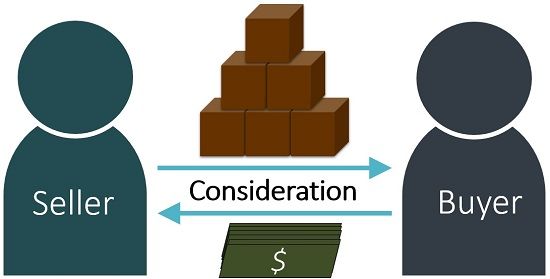
Consideration is price of the promise. It is in nature of quid pro quo, that is, something for something. It is the price for which the promise of other is brought and promise thus given for value is enforceable. Consideration is “some right, interest, profit or benefit accruing to one party or forbearance, detriment, loss, or responsibility given, suffered or undertaken by the other”. This refers to the position of both the promisor, and the promisee in an agreement.

https://youtu.be/9ZbdmkODW_0


In law, When at the desire of the promisor (person making the proposal), the promisee (person accepting the proposal) or any other person has done or abstained from doing, or does or abstains from doing, or promises to do or to abstain from doing, something, such act or abstinence or promise is called a Consideration for the promise.


Consideration 


From the above definition it can be inferred that

  1. Consideration is doing or not doing something

  2. Consideration must be at the desire of the promisor

  3. Consideration may move from one person to any other person

  4. Consideration may be past, present or future

  5. Consideration should be real though not adequate

For example, A promises to sell his house to B for Rs. 5 lakhs. Here, A is the promisor and B is the promisee. B agrees to buy the house for the said price. Here, B will be the promisor and A will be the promisee. That is, A must part with the house and B must part with Rs. 5 lakhs. Thus, Consideration is mutual and has two sides.

It is also possible that there may not be any identifiable benefit towards consideration. For example, A promises to carry B’s goods free of charge and B allows A to carry the same. Here B has suffered a detriment or disadvantage while allowing A to carry his goods. This is sufficient consideration.

Above example shows that Consideration has dual aspect. It is not necessarily a gain or advantage to the promisor but it can even be a loss or detriment to the promisee.

Similarly in a contract of guarantee of Loan, where A applies for a loan from Bank B, and if B insists on a guarantee by G. B gives loan to A on G’s guarantee. Here, G will be promisor and B promisee. The benefit conferred on A by B at the guarantee of G, is sufficient consideration for G. In other words B has suffered a detriment which is the consideration for the guarantee of G to repay the loan which B has given to A. Detriment to one is benefit to another.

But Consideration is sine qua non for a contract. In the absence of consideration, a gratuitous promise will not result in an agreement. For example, a promise to subscribe to a charitable cause cannot be enforced.

Essentials of a Consideration

  1. Consideration must move at the desire of the promisor.

  2. Consideration can flow either from the promisee or any other person. That is, consideration can legitimately move from a third party. For example, A by a deed of gift made over certain property to her daughter D with condition that A’s brother B should be paid annuity by D. In furtherance, D executes a document on the same day agreeing to pay the annuity accordingly, but declined to pay after sometime. B sued D. D contends that there was no consideration from B and hence there was no valid contract. Held, that the consideration did flow from B’s Sister A to D. Such consideration from third party is sufficient to enforce the D’s promise.

  3. Consideration may be past, present or future. For example where A pays Rs. 5000/- to B requesting him to deliver certain quantity of rice, to which B agrees. The consideration for B is present (or executed) as A has already paid, while for A, consideration is future (or executory) as B is yet to deliver the rice.

    Similarly, when A pays a premium of Rs. 5000/- seeking insurance cover for the year, from the insurance company which the company promises in the event of fire, the consideration paid by A to the insurance company is executed but the promise of insurance company is executory or yet to be executed.

    Consideration may also be constituted in the past acts of promisee, but the act must have been non-gratuitous and also at the desire of the promisor.

  4. Consideration must be real and not illusionary. It must be something of value.

  5. Consideration need not be adequate. That is to say, consideration need not necessarily be of the same value as of the promise for which it is exchanged. For example, A may very well sell his motorbike valued at Rs. 50,000/- for a sum of Rs. 10,000/-

    Law leaves the party to make their own bargain. Inadequate consideration would not invalidate an agreement but inadequate consideration raise suspicion over free will and could be taken into account by the court in deciding whether the consent of the promisor was freely given. (Topic of free consent dealt with separately)

  6. The performance of an act by a person what he is legally bound to perform, cannot be consideration for a contract. For example, a promise to pay money to a witness for giving evidence is void. The witness is legally bound to furnish evidence and hence there is no consideration.

    But where a person promises to do more than he is legally bound to do is a good consideration. For example, Police is bound to maintain law and order and protect person and property. But where police provides stationary guard at request of owner of property on agreed price for such service. It was held that the promise to pay the amount was not without consideration. The police, no doubt, were bound to afford protection, but they had discretion as to the form it should take. The undertaking to provide more protection than what they deemed to be necessary was a consideration for the promise of reward.

  7. Consideration must not be unlawful, immoral, or opposed to public policy.

  8. Consideration may be positive or negative. Consideration is positive when some act needs to be done. It is negative when some act is to be purposely omitted.

Agreement without Consideration

The general rule is that an agreement without consideration is void. However, there are certain exceptions to the general rule. They are –

1. Agreement on account of Natural love and affection:

Such an agreement must be –

  • In writing and registered

  • Made on account of natural love and affection

  • Between parties standing in a near relation to each other

In aforementioned conditions, an agreement is enforceable by law even without consideration.


2. Compensation paid for past voluntary services:

Such an agreement must be –

  • A promise to compensate

  • Wholly or in part

  • Person rendered services to the promisor

  • Such service was rendered voluntarily.

That is, a promise to compensate wholly or in part for past voluntary services rendered by someone to promisor does not require consideration for being enforced. However the past services must have been rendered voluntarily to the promisor. Further the promisor must have been in existence at that time and he must have intended to compensate.

3. Promise to pay debts barred by limitation:

Such an agreement must be –

  • A promise, made in writing

  • Signed by the person to be charged therewith, or by his agent

  • To pay

  • Wholly or in part

  • A time barred debt

That is, Where there is a promise in writing to pay a debt, which was barred by limitation, is valid without consideration. The law of limitations prescribes time within which an action must be initiated, after the lapse of which the same is called barred by time or limitation.

4. Creation of Agency:

By law, no consideration is necessary to create an agency. An “agent” is a person employed to do any act for another or to represent another in dealings with third persons.

5. Gifts actually made

In case of completed gifts, no consideration is necessary.

p { margin-bottom: 0.25cm; line-height: 115%; background: transparent }

Law of Contract – Communication of Offer, Acceptance & Revocation

 COMMUNICATION OF OFFER, ACCEPTANCE & REVOCATION

Communication is an indispensable element in concluding a contract. There must be effective communicationof both ‘offer’ and ‘acceptance’ to give rise to a valid contract.

Importance of communication lies in the fact that parties are separated by distance and they employ modes such as post, telegram, fax, email, telephone etc. Effective and proper communication prevents avoidable misunderstanding between parties.

Lawgives a lot of importance to “time” element in deciding when the offer and acceptance is complete, and upto what time offer or acceptance may be revoked.


Communication of offer

Communication of offer is complete when it comes to the knowledge of the person to whom it is made. Knowledge of the offer would materialize when the offer is given in writing or made by word of mouth or by some other conduct. For Example,

  1. A’ writes a letter making a proposal to ‘B’ to sell his house for Rs. 5 lakhs. The letter is posted on 15th Jan and reaches B on 18th Jan, the offer is said to have been communicated on 18th Jan when B received the letter.

  2. In telephonic communications, communication of offer is complete as soon as the voice is heard by the person receiving the offer.

Communication of acceptance

Communication of acceptance may be oral or written, that is by way of letters, telegrams, faxes, emails, telephonic conversion. Communication of acceptance canalso bedone by conduct. For instance, delivery of goods at a price by a seller to a buyer on receipt of tender. The delivery of goods is communication of acceptance byconduct. Similarly, boarding abus or dropping currency in a vending machineis acceptance by conduct.

But a mere mental unilateral assent in one’s own mind would not amount to acceptance. For example, A receives an offer to buy B’s house for certain price. A decides to buy the same but does not say anything to B. There is no acceptance as there is no communication of the same.

As to when the communication is complete, the law is that the communication of acceptance is complete –

  1. As against the proposer, when it is put in course of transmission to him so as to be out of the power of the acceptor to withdraw the same;

  2. As against the acceptor, when it comes to the knowledge of the proposer.


The above rule may appear complicated, but can be understood by simple illustration. If in above example where offer is sent by letter, B writes letter of acceptance andposts iton 20thJan which is received by A on 24thJan.The communication of acceptance is complete as against A (proposer)on 20th Janand against B (acceptor)on 24thJan.

Here, A the proposer will be bound by B’s acceptance, even if the letter of acceptance is delayed in post or lost in transit. The golden rule is proposer becomes bound by the contract, the moment acceptor has posted the letter of acceptance. But it is necessary that the letter is correctly addressed, sufficiently stamped and duly posted. In such an event the loss of letter in transit, wrong delivery, non delivery etc., will not affect the validity of the contract.

However from the view point of acceptor, he will be bound by his acceptance only when the letter of acceptance has reached the proposer. If there is no delivery of the letter, the acceptance could be treated as having been completed from the viewpoint of proposer but not from the viewpoint of acceptor. This will, however,give rise to an awkward situation whereonly one party to the contract being treated as bound by the contract though no one would be sure as to where the letter of acceptance had gone.


REVOCATION OFOFFERANDACCEPTANCE

Similar to rules for communication of offer and acceptance, there are rules for communication of revocation of such offer and acceptance.

As far as revocation of proposal is concerned, a proposal may be revoked by

  1. Communication of notice of revocation

  2. Lapse of the time prescribed in such proposal or if no time is so prescribed, by the lapse of a reasonable time.

  3. Failure of the acceptor to fulfil a condition precedent to acceptance. For example, A proposes to sell his car to B for Rs. 2 lakhs provided B sels his motorbike A. If B refuses to sell his bike, the offer of A is revoked automatically.

  4. Death or insanity of the proposer, if the fact of his death or insanity comes to the knowledge of the acceptor before acceptance.


A proposal can be revoked at any time before the communication of its acceptance is complete as against the proposer. An acceptance may be revoked at any time before the communication of acceptance is complete as against the acceptor.

This may appear technical. But can be understood from aforesaid example of communications by letter. A may revoke his proposal to B, before B post his letter of acceptance, that is, by 20th Jan and not thereafter. Further, B may revoke his acceptance before the letter of acceptance is received by A, that is, by 24thJan and not thereafter.

As to time, the communication of revocation (of the proposal or its acceptance) is complete –

  1. as against the person who makes it when it is put into a course of transmission to the person to whom it is made so as to be out of the power of the person who makes it, and

  2. as against the person to whom it is made, when it comes to his knowledge.

p { margin-bottom: 0.25cm; line-height: 115%; background: transparent }

Law of Contract – Acceptance


ACCEPTANCE

A proposal or offer is said to have been accepted when the person to whom the proposal is made signifies his assent to the said proposal. Act of acceptance lies in signifying one’s assent to the proposal.

According to Sir William Anson “Acceptance is to offer what a lighted match is to a train of gun powder”. That is what acceptance triggers cannot be recalled or undone. But there is a choice to the person who had the train to remove it before the match is applied. It in effect means that the offer can be withdrawn just before it is accepted. Acceptance converts the offer into a promise and then it is too late to revoke it. The significance of this is an offer by itself cannot create any legal relationship but it is the acceptance by the offeree which creates a legal relationship.


Essentials of a Valid Acceptance

  1. For a valid acceptance, there must be knowledge of offer. Without knowledge of offer, there can be no acceptance. For example, where a person finds a missing dog without knowledge of award, he cannot claim the award afterwards.

  2. The acceptance must be communicated. To conclude a contract between the parties, the acceptance must be communicated in some perceptible form.

  3. Acceptance must be made by the promisee himself or any person having authority to accept on his behalf.

  4. The acceptance must relate specifically to the offer made.

  5. Acceptance must be absolute and unqualified.

  6. It should be expressed in some usual and reasonable manner unless the proposal prescribes the manner in which it must be accepted. If the proposal prescribes the manner in which it must be accepted, then it must be accepted accordingly.

  7. The acceptance must be given within a reasonable time and before the offer lapses.

  8. Acceptance may be express or implied. It may also be expressed by conduct.

  9. But mere silence is not acceptance. As already stated, the burden to refute the offer cannot be placed on the promisee.


Illustrations

  1. A offers to B to sell A’s car for Rs. 2 lacs. If B replies – “I shall purchase your car for the said price, if A buys B’s motorcycle for Rs. 50000/-.” This is no acceptance as it is conditional. By its very nature, it is a counter offer to A, who may accept or deny it.

  2. If, in the above example, B agrees to purchase the car from A as per his offer if A has a valid Registration Certificate. The acceptance is a valid one. This is because expecting a valid title for the car is not a condition.

  3. A offers to sell his house to B for Rs 5,00,00/-. B replied purporting to accept the offer but enclosed a cheque for Rs 2,00,000/- only and promises to pay the balance in monthly installments. Acceptance is invalid not being an unqualified one.

  4. A offers to sell his car to B for Rs. 1,00,000/-. B replied that, “I can pay Rs. 80,000 for it.” A’s offer stands rejected. Later on, if B decides to pay Rs. 1,00000/-, the same will be a counter offer only as A’s offer was already rejected.

  5. A, a trader, receives an order from B. The order is executed accordingly by the trader. A has made acceptance to the offer by his conduct.

  6. A boards a bus to Delhi. A’s conduct amounts to acceptance.

p { margin-bottom: 0.25cm; line-height: 115%; background: transparent }

Law of Contract – Proposal


PROPOSAL


The word ‘proposal’ or‘offer’ meansto give option to someone to agree or deny. In terms of Contracts, a person is said to make a proposal when he signifies to another his willingness to do or abstain from doing anything with a view to obtaining the assent of that other to such act or abstinence. From this definition, one can make out following ingredients of a Proposal –

  1. It is an expressions of willingness

  2. To do or to abstain from doing an act, that is, it may be for doing an act or making an omission

  3. Expressed with a view to obtain the assent of the other party to whom the offer is made.


For example –

  1. A” offers to sell his car to “B”. This is proposal as it conveys A’s willingness to do an act and also solicits B’s assent.

  2. A” offers to “B” to omit bidding at an auction event, where B intends to bid, for payment of a sum. This is proposal.

  3. Where “A” says to “B” that he intends to marry B by the end of the year. This is no offer, unless, he also asks “Will you marry me?”


Classification of Proposal/Offer

Offer can be classified as general offer, specific offer, cross offer, counter offer, standing/open/continuing offer.

(a) General offer

It is an offer made to public at large. Until the general offer is retracted or withdrawn, it can be accepted by anyone. Thus, it is continuing is nature. For example, SMS Code to win contestsare general offers. Any person who sends the code inside the packet is actually accepting the general offer. Similarly, where A advertises that he will Rs 500/- to anyone who brings back his lost dog. He makes a general offer. A vending machine at the airport, A bus at the bus stop ready to ply are in their nature general offers.

(b) Special/Specific offer

Where an offer is made to a particular person, it is a specific offer. Only that person can accept such specific offer, as it is exclusive to him.

(c) Cross offer

Cross offers are offers made to each other in ignorance of offer of the other. For example, if A makes a proposal to B to sell his carat a specified price and B, without knowing proposal of A, makes a proposal to purchase the same carat the same price. The offers are cross offers. And one is not acceptance of other.Nor isthere anybinding contract between them by mere exchange of proposals.

(d) Counter offer

Counter offer is an offer made in response to another offer. If,upon receipt of an offer, the offeree instead of accepting it straightway, imposes conditions which have the effect of modifying or varying the offer, he is said to have made a counter offer.

For example, A says to B – “Will you buy my car for Rs. 50,000/-?” And B replies – “I will do it for Rs. 45,000/-.” B is making a counter offer. Counter offers amounts to rejection of the original offer. Thus, B cannot, at a later stage, say that he accepts A’s offer for Rs. 50,000/- and bind him with his proposal.

(e) Standing or continuing or open offer

An offer which is kept open for acceptance for a certain period of time is known as standing or continuing or open offer. For example, A offers to supply coal to B for running thermal power plant for a period of one year at a particular price. This is a continuing offer. And each time an order is placed, the same is acceptance.


Essentials of a Valid Proposal/Offer

An offer must adhere to certain rules to be a valid offer. They are as follows –

  1. The ‘offer’ must be with intent to create a legal relationship and not mere social relationship. Thus, an invitation for dinner is not an offer.

  2. The offer must be certain and definite. It must not be vague. For example, where ‘A’ offers to sell 100 litres of oil, without indicating what kind of oil would be sold, it is a vague offer and hence cannot create any contractual relationship. If however there is a mechanism to end the vagueness, the offer can be treated as valid. Thus, if in the above example if ‘A’ does not deal in any oil but only in Mustard oil and this is matter of common knowledge, the offer is not vague but a valid offer.

  3. It may be express or implied.

  4. It must be distinguished from an invitation to offer.

  5. The offer must be communicated to the person to whom it is made. This communication may be made by act or omission by which the person intends to communicate, or which has the effect of communicating it. An un-communicated offer cannot be accepted. So, if A writes a letter offering to sell his house for a price to B and keeps the letter in his desk drawer. A does not make an offer since he has not posted the letter.

  6. The offer must be made with a view to obtain the assent of the promisee.

  7. An offer may be conditional. But burden to refute cannot be placed on the promisee. That is, the promisor cannot say that if non-acceptance is not communicated by a certain time the offer would be treated as accepted.


Invitation to Offer

An offer must be distinguished from a mere invitation to offer. An offer is definite andexpresses willingness with a view to obtain assent and if assent is given thereto, the contract is concluded.

An invitation to offer is an act precedent to making an offer. An invitation to offeris – “…an expression of willingness to negotiate. A person making an invitation to treat does not intend to be bound as soon as it is accepted by the person to whom the statement is addressed.”

An invitation to offer gives rise to an offer after due negotiation and it cannot be per se accepted. In an invitation to offer there is no expression of willingness by the offeror to be bound by his offer. It is only a proposal of certain terms on which he is willing to negotiate. It is not capable of being accepted as it is.

The essence of an invitation to offer is that the offer is actually made by the seller. For example, An advertisement in newspaper. The reason is that it does not make business sense for advertisements to be offers, as the person making the advertisement may find himself in a situation where he would be contractually obliged to sell more goods than he actually owned.

Similarly, a display of clothes in a shop, of goods in an auction, and even advertisements screaming “Offer! 50% Off on All Shirts!” is actually an invitation to treat, and not an offer.

Therefore, an invitation to offer ‘evolves’ into a contract in a different manner than an offer. Initially, it is an invitation to offer, say by a display of goods and their prices. When a person makes an offer that is good enough and the seller ‘accepts’ it, it becomes a contract.

The test to decide whether a statement is an ‘offer’ or ‘invitation to offer’ is to see the ‘intention’. If a person who makes the statement has the intention to be bound by it as soon as the other accepts, he is making an offer. If he however intends to do some other act, he is making only an invitation to offer.

Where the owner of the property had said that he would not accept less than Rs.6000/- for it. The statement doesnot indicate any offer but only an invitation to offer. Similarly, in an auction, goods put up for auction are invitation while the bids are offer. Somekey examples of Invitation to offer are –

  • Menu card of a restaurant showing the prices of food items.

  • Railway Chart setting out train timings and fares.

  • Government Tender

  • An invitation by a company to the public to subscribe for its shares.

  • Recruitment advertisement inviting application.

  • Quotation of prices sent in reply to a query regarding price.

p { margin-bottom: 0.25cm; line-height: 115%; background: transparent } strong { font-weight: bold }

Law of Contract – Bird Eye View


LAW OF CONTRACT


The term ‘Contract’ is of common parlance meaning ‘to make bargain’. In law, it has a specific definition – An agreement enforceable by law is a Contract.

Agreement again means, in common parlance, as something agreed upon. In law, Every promise and every set of promises forming consideration of each other is an agreement. This definition employs two terms – Promise and Consideration.

Promise is an accepted proposal. Proposal means to make an offer. Legally speaking, when one person signifies to another his willingness to do or to abstain from doing something with a view to obtain the assent of that other, he is said to make a proposal. Acceptance means signifying assent or agreeing to the proposal brought forth.

Consideration is price of the promise. It is in nature of quid pro quo, that is, something for something. It is the price for which the promise of other is brought and what make the promise enforceable. In law, When at the desire of the promisor (person making the proposal), the promisee (person accepting the proposal)or any other person has done or abstained from doing, or does or abstains from doing, or promises to do or to abstain from doing, something, such act or abstinence or promise is called a Consideration for the promise.

Thus, we mathematically represent these relations as –

Promise = Proposal + Acceptance

Agreement = Promise + Consideration

Contract = Agreement + Legal Enforceability


As far as enforceability of an agreement is concerned, all agreements are contracts if they are made by the free consent of parties competent to contract, for a lawful consideration and with a lawful object, and are not hereby expressly declared to be void. Thus, Legal Enforceability of Agreement requires following prerequisites –

  • Intention to Contract

  • Competent Parties

  • Free Consent

  • Lawful Object

  • Lawful Consideration

  • Not expressly declared void

p { margin-bottom: 0.25cm; line-height: 115%; background: transparent }

जानिए चेक बाउंस केस की पूरी प्रक्रिया

 💐💐💐💐💐💐💐💐💐💐💐

By :- मोहित भाटी एडवोकेट

💐💐💐💐💐💐💐💐💐💐💐

# चेक के बाउंस  होने की स्थिति में पीड़ित पक्ष के पास माननीय न्यायालय के समक्ष परिवाद  योजित करने का अधिकार होता है जोकि Negotiable Instruments Act, 1881 (परक्राम्य लिखत अधिनियम, 1881) की धारा 138 के अन्तर्गत दिया गया है। परक्राम्य लिखत अधिनियम, 1881 की धारा 138 के अनुसार चेक बाउंस होने की स्थिति में 2 वर्ष का कारावास या जितनी धनराशि का चेक है उससे दोगुनी धनराशि  माननीय न्यायालय पीड़ित पक्ष को देने का आदेश फरमा सकता है अथवा दोनो। चेक बाउंस के मामले में फर्स्ट क्लास मजिस्ट्रेट के न्यायालय में सुनवाई होती । वर्तमान समय में अधिकांश भुगतान चेक के माध्यम से किए जा रहे हैं। क्योंकि कानूनन 20,000 / रूपए से ज्यादा का नकद लेन-देन नही किया जा सकता। किसी भी व्यापारिक एवं पारिवारिक क्रम में लोगों द्वारा एक दूसरों को चेक दिए जा रहे हैं। चेक के अनादर हो जाने के कारण चेक बाउंस जैसे मुकदमों की भरमार न्यायालय में हो रही है। नए अधिवक्ताओं के लिए चेक बाउंस का मुकदमा संस्थित करना और कार्यवाही करना रोचक होता है और उनके लिए इस प्रकार  के मामलो मे सीखने के लिए बहुत कुछ होता है, जहां नए अधिवक्ता इस चेक बाउंस के प्रकरण को संस्थित करवाने में बहुत सारे विधि के प्रश्न और प्रक्रियाओं को समझते हैं। इस लेख के माध्यम से चेक बाउंस के केस को क्रमवार प्रक्रिया स्वरूप समझाया जा रहा है। यहाँ भी दी जा रही जानकारी आप सभी के लिए बहुत ही महत्त्वपूर्ण  है,चाहे फिर आप आम आदमी हो,व्यापारी हो,फिर विधी के छात्र या फिर अधिवक्ता।

चैक बाउंस का केस कहां और किस अधिनियम की किस धारा के अंतर्गत फाईल किया जाएगा ?

चैक बाउंस होने की स्थिति में पानेवाला व्यक्ति/चैक धारक Negotiable Instrument Act, 1881/परक्राम्य लिखत अधिनियम 1881 की धारा 138  के अंतर्गत ऐसे फस्ट क्लास मजिस्ट्रेट के न्यायालय में केस फाइल कर सकता है जहां चैक धारक खाता रखता  है, जहां चैक अनादरित/बाउंस हुआ है या फिर उस न्यायालय में भी केस फाइल किया जा सकता है जिसके क्षेत्राधिकार के भीतर चेक जारी किया गया  है।

धारा 138 के अधीन दंडनीय अपराध की जांच एवं विचारण केवल किसी ऐसे न्यायालय द्वारा किया जाएगा जिसके क्षेत्राधिकार के भीतर  चेक जारी किया गया है या जहां पर चैक बाउंस हुआ है।

चैक धारक व्यक्ति को चैक प्राप्ति के तीन माह के भीतर चैक को अपने खाते  में ( जिस बैंक की शाखा में उसका खाता है) भुगतान के लिए प्रस्तुत करना आवश्यक है।

और यदि किसी  कारणवश चेक बाउंस हो जाता है। जैसे बैंक से खाता बंद कर दिया जाना, अकाउंट में पैसा नहीं होना, या फिर चेक के भुगतान को रोक  दिया जाना/Stop Payment या फिर चैक पर चैक जारी कर्ता द्वारा फ़र्जी हस्ताक्षर करना आदि।

जब भी चेक अनादर होता है तो ऐसे अनादर पर चेक को प्राप्त करने वाले व्यक्ति के पास चेक बाउंस का प्रकरण दर्ज कराने का अधिकार होता है।

चेक बाउंस होने के मुख्य कारण  :- (1) चेक देने वाले व्यक्ति के खाते में पर्याप्त धनराशि न होना। ( Insufficient funds )

(2) चेक देने वाले व्यक्ति द्वारा बैंक मैनेजर से कह कर चेक का भुगतान रूकवा देना। (Stop Payment)

(3) जिस खाते का चेक दिया गया है,उसका पहले से बन्द होना। ( Cheque of a close account )

(4) चेक का कटा-फटा होना या हस्ताक्षर miss match होना।

(5) तय समय सीमा के बाद चेक को भुगतान के लिए बैंक में प्रस्तुत करना।( Presentation of the cheque after expiry date i.e 3 month )

चेक बाउंस एक आपराधिक मामला :  चेक बाउंस का मामला एक आपराधिक मामला होता है, जिसकी कार्यवाही  फर्स्ट क्लास मजिस्ट्रेट या मेट्रोपॉलिटन मजिस्ट्रेट के न्यायालय में की जाती है। लेनदेन के मामले सिविल प्रकृति के होते हैं, परंतु चेक बाउंस के मामले को आपराधिक प्रकृति का माना गया है।

Negotiable Instrument Act, 1881/परक्राम्य लिखत अधिनियम 1881 की धारा 138 द्वारा इसे एक दण्डनीय अपराध माना गया है जिसके अंतर्गत दो साल की सजा या बाउंस हुए चेक की धनराशि से दोगुनी धनराशि तक का जुर्माना अथवा दोनो से दण्डित किया जा सकता है।

लीगल नोटिस :- चेक बाउंस के प्रकरण की शुरुआत लीगल नोटिस के माध्यम से की जाती है।  चेक बाउंस होने के  30 दिनों के भीतर चेक देने वाले व्यक्ति को एक लीगल नोटिस स्पीड पोस्ट या साधारण डाक द्वारा दिया जाना परम आवश्यक है। जिसकी प्रतिलिपि और असल डाक रसीद केस फाइल करते समय साक्ष्य के रूप में माननीय न्यायालय के समक्ष प्रस्तुत करनी परम आवश्यक है। यह जरूरी नही है कि लीगल नोटिस केवल अधिवक्ता के माध्यम से ही दिया जाए बल्कि लीगल नोटिस वादी स्वंय भी दे सकता है। परन्तु चेक बाउंस का केस मुख्यतः लीगल नोटिस पर ही निर्भर करता है इसलिए लीगल नोटिस को किसी अधिवक्ता के माध्यम से ही भेजना चाहिए ताकि उसमे विधिक रूप से किसी प्रकार की त्रुटी की सम्भावना ना रहे।

लीगल नोटिस में चेक किस वजह से जारी किया गया,दोनो पक्षो के बीच किस प्रकार का लेन-देन होता है,चेक बाउंस हो जाने के कारण तथा नोटिस प्राप्ति के 15 दिन के भीतर राशि चेक देने वाले व्यक्ति से वापस देने का निवेदन किया जाता है। चेक बाउंस के प्रकरण में बैंक से Return memo मिलने के 30 दिन के भीतर लीगल नोटिस भेजना  होता है। 30 दिन के बाद लीगल नोटिस भेजा जाता है तो न्यायालय में चेक बाउंस प्रकरण को संस्थित किए जाने का अधिकार चेक रखने वाला व्यक्ति खो देता है।

  लीगल नोटिस द्वारा 15 दिन का समय भुगतान किए जाने के लिए या चेक बाउंस के संबंध में मध्यस्थता करने के लिए चेक देने वाले व्यक्ति को दिया जाता है। उस समय के बीत जाने के बाद 30 दिन के भीतर न्यायालय में चेक बाउंस का प्रकरण दर्ज कर दिए जाने का अधिकार चेक प्राप्त करने वाले पक्षकार को प्राप्त हो जाता है। किसी युक्तियुक्त कारण से न्यायालय इस 30 दिन की अवधि को बढ़ा भी सकता है, लेकिन कारण युक्तियुक्त होना चाहिए।

  लीगल नोटिस कैसे दे  :-  लीगल नोटिस

स्पीड पोस्ट या रजिस्टर एडी के माध्यम से भेजा जाता है तथा इससे जो रसीद प्राप्त होती है वह चेक बाउंस का वाद योजित करते  समय दस्तावेज का काम करती है। चेक देने वाले व्यक्ति का पता सही होना चाहिए और उसे उसी पते पर लीगल नोटिस दिया जाना चाहिए।

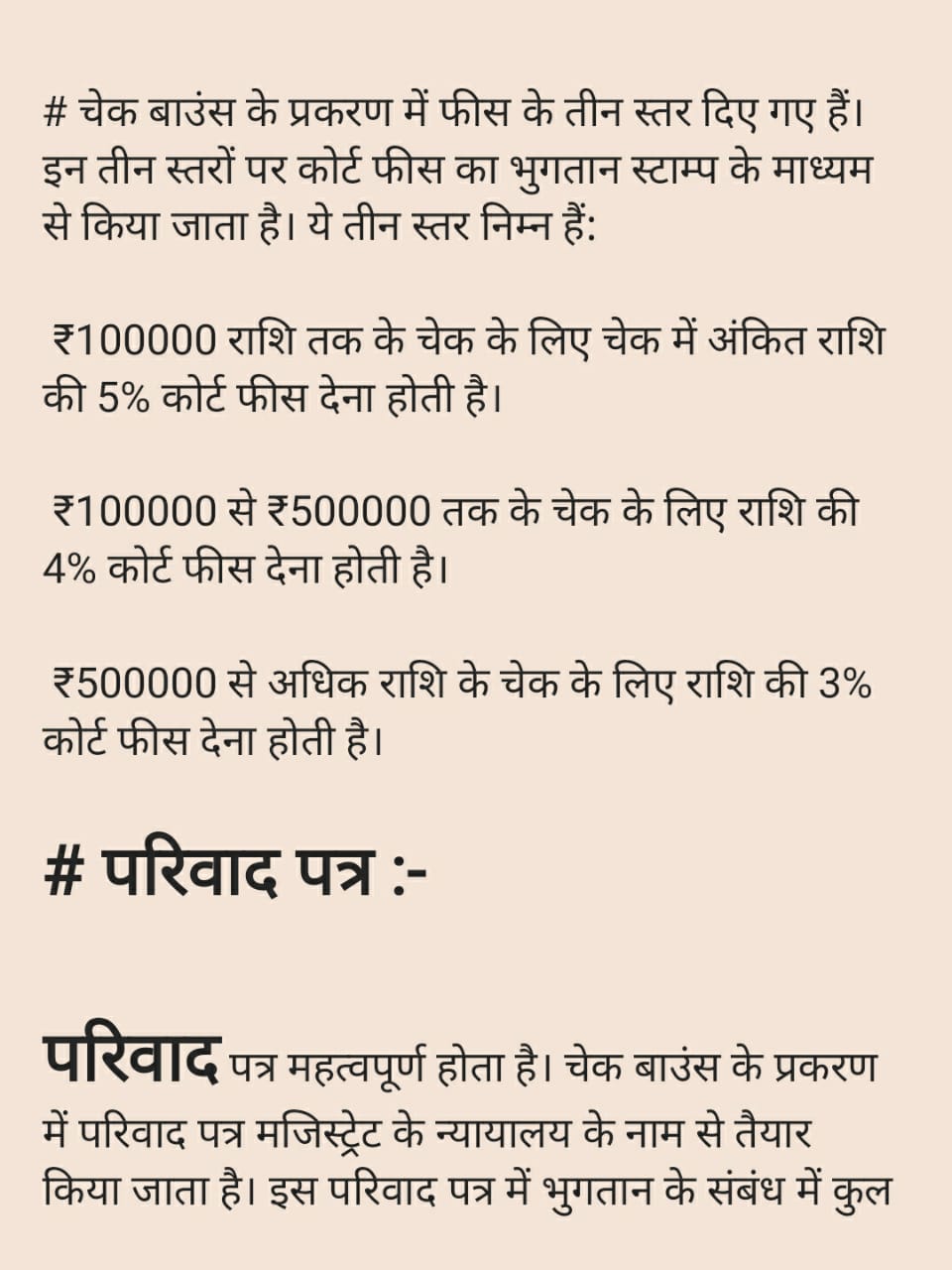
 मजिस्ट्रेट के न्यायालय का निर्धारण :- जिस थाना क्षेत्र के अंतर्गत वह बैंक होता है, जिस बैंक में चेक को भुनाने के लिए लगाया गया है और चेक बैंक में अनादर हो गया है, उस थाना क्षेत्र के क्षेत्राधिकार वाले न्यायालय में इस चेक बाउंस के परिवाद को संस्थित किया जाता है। कोर्ट फ़ीस चेक बाउंस के प्रकरण में कोर्ट फीस महत्वपूर्ण चरण होता है।

चेक बाउंस के प्रकरण में फीस के तीन स्तर दिए गए हैं। इन तीन स्तरों पर कोर्ट फीस का भुगतान स्टाम्प के माध्यम से किया जाता है। ये तीन स्तर निम्न हैं:

₹100000 राशि तक के चेक के लिए चेक में अंकित राशि की 5% कोर्ट फीस देना होती है।

₹100000 से ₹500000 तक के चेक के लिए राशि की 4% कोर्ट फीस देना होती है।

₹500000 से अधिक राशि के चेक के लिए राशि की 3% कोर्ट फीस देना होती है।

 परिवाद पत्र :-

परिवाद पत्र महत्वपूर्ण होता है। चेक बाउंस के प्रकरण में परिवाद पत्र मजिस्ट्रेट के न्यायालय के नाम से तैयार किया जाता है। इस परिवाद पत्र में भुगतान के संबंध में कुल लेनदेन का जो व्यवहार हुआ है, उस व्यवहार से संबंधित सभी बिंदुओं पर मजिस्ट्रेट को संज्ञान दिया जाता है तथा इस परिवाद पत्र में परिवादी का शपथ पत्र भी होता है जो शपथ आयुक्त द्वारा रजिस्टर होता है। चेक की मूल प्रति अनादर रसीद लीगल नोटिस की प्रति लीगल नोटिस भेजे जाते समय एक रसीद प्राप्त होती है, जिसे सर्विस स्लिप कहा जाता है, जिसमें लीगल नोटिस भेजे जाने का दिनांक अंकित होता है। वह स्लिप दस्तावेजों में लगानी होती है। गवाहों की सूची अगर प्रकरण में कोई गवाह है तो गवाहों की सूची भी डाली जाएगी।

 प्रकरण रजिस्टर होना :- जब सारे दस्तावेज तैयार कर परिवादी द्वारा अपने अधिवक्ता के माध्यम से माननीय न्यायालय के समक्ष प्रस्तुत कर दिए जाते हैं तो परिवाद न्यायालय द्वारा रजिस्टर कर लिया जाता है और एक परिवाद संख्या  न्यायालय द्वारा अलॉट कर दिया जाता है।

 सम्मन :- परिवाद दर्ज हो जाने के बाद विपक्षी को माननीय न्यायालय द्वारा सम्मन जारी किया जाता है। सम्मन में न्यायालय द्वारा विपक्षी को माननीय न्यायालय के समक्ष निर्धारित दिनांक और समय पर  उपस्थित होने हेतु आदेश दिया  जाता है।

पुनः सम्मन :- यदि आरोपी न्यायालय में उपस्थित होकर उक्त परिवाद में अपने लिखित अभिकथन नहीं कर रहा है तो ऐसी परिस्थिति में पुनः सम्मन न्यायालय द्वारा भेजा जाता है।

वारंट :–   यह प्रकरण एक आपराधिक प्रकरण होता है, जिसे प्रथम श्रेणी मजिस्ट्रेट के न्यायालय द्वारा सुना जाता है। इस प्रकरण में आरोपी को बुलाने के लिए वारंट भी जारी किए जा सकते हैं। यदि आरोपी सम्मन के द्वारा माननीय न्यायालय में उपस्थित नहीं हो रहा है तो न्यायालय अपने विवेक के अनुसार जमानती या गैर जमानती किसी भी भांति का वारंट आरोपी के नाम संबंधित थाना क्षेत्र को जारी कर सकता है।

जमानत की प्रक्रिया:- चेक बाउंस के मामले में विपक्षी जब पहली बार माननीय न्यायालय के समक्ष उपस्थित होता है तो उसे माननीय न्यायालय में अपने अधिवक्ता के माध्यम से जमानत प्रार्थना पत्र देना होता है। चूंकि यह एक जमानतीय अपराध है इसलिए न्यायालय द्वारा विपक्षी को बिना जेल भेजे ही जमानत स्वीकार कर ली जाती है।

प्रति परीक्षण (Cross Examination) :- आरोपी जब न्यायालय में उपस्थित होता है तो वह निगोशिएबल एक्ट की धारा 145(2) का आवेदन देकर न्यायालय से क्रॉस प्रति परीक्षण (Cross Examination) करने का निवेदन करता है तथा न्यायालय द्वारा आरोपी पक्षकार को क्रॉस करने की अनुमति दी जाती है।

💐 उपधारणा करना :- इस प्रकरण में न्यायालय अवधारणा करता है कि चेक देने वाला व्यक्ति दोषी ही होगा अर्थात उसने चेक दिया ही है। चेक प्राप्त करने वाला व्यक्ति कहीं ना कहीं सही है। अब यहां पर आरोपी पक्षकार यह सिद्ध करेगा कि उसके द्वारा कोई चेक नहीं दिया गया है। यहां साबित करने का भार आरोपी पर होता है। यदि माननीय न्यायालय चाहे तो सुनवाई से पहले विपक्षी को चेक की कुल धनराशि का 20 % प्रतिशत तक परिवादी को देने का आदेश दे सकता है।

💐 समरी ट्रायल  :- यह एक समरी ट्रायल होता है, जिसे न्यायालय द्वारा शीघ्र निपटाने का प्रयास किया जाता है। इसमें बचाव पक्ष को बचाव के लिए साक्ष्य का उतना अवसर नहीं होता है, जैसा कि अवसर सेशन ट्रायल में होता है।

💐 समझौता योग्य अपराध ( Compoundable offense ) :- यह अपराध समझौता योग्य होता है। यदि दोनों पक्षकार सुनवाई के दौरान आपस में समझौता कर न्यायालय से इस प्रकरण को खत्म करना चाहते हैं तो समझौता कर दिया जाता है तथा अपराध का शमन हो जाता है। 2018 में संशोधन किया गया है। यह संशोधन धारा 143 ए है जो नेगोशिएबल इंस्ट्रूमेंट एक्ट की है। इस धारा के अंतर्गत परिवादी पक्षकार एक आवेदन के माध्यम से आरोपी से अपने संपूर्ण धनराशि जो चेक में अंकित की गई है उसका 20% हिस्सा न्यायालय द्वारा दिलवाए जाने के लिए निवेदन कर सकता है और न्यायालय अपने आदेश के माध्यम से आरोपी से ऐसी धनराशि परिवादी को दिलवा सकता है।

💐 अंतिम बहस  :- यदि आरोपी प्रकरण में समझौता नहीं करता है और मुकदमे को आगे चलाना चाहता है तो ऐसी परिस्थिति में न्यायालय द्वारा आरोप तय कर मामले को अंतिम बहस के लिए रख दिया जाता है तथा दोनों पक्षकारों द्वारा आपस में अंतिम बहस होती।

💐 निर्णय (Order) :- अंत में मामला निर्णय पर आता है तथा कोर्ट इस प्रकरण में दोषसिद्धि होने पर आरोपी को 2 वर्ष तक का सश्रम कारावास या  या जितनी धनराशि का चेक है उससे दोगुनी धनराशि  माननीय न्यायालय पीड़ित पक्ष को देने का आदेश फरमा सकता है अथवा दोनो।

जमानतीय अपराध :- यह एक जमानतीय श्रेणी का अपराध है, जिसमें यदि आरोपी की दोषसिद्धि हो जाती है और उसे न्यायालय द्वारा कारावास कर दिया जाता है तो ऐसी परिस्थिति में वह ऊपर के न्यायालय में अपील कर जमानत ले सकता है। इस अपराध में किसी भी स्तर पर समझौता किया जा सकता है।


Some Common Torts – Definitions & Remedies


SOME COMMON TORTS


Law recognises many torts and assign specific names to them. These torts have specific ingredients and may have special defences apart from general defences discussed earlier. It must be understood that wherever the recognises a Civil right and protects the same from infringement by people at large, an action under tort may be initiated; although no specific name has yet been assigned to the said wrongful act or tort. Conversely, whenever law prescribes a duty towards persons generally, the breach of the same is redressable by action for tort. This is because there exists a general law of tort apart from law of torts.

In other words, law is capable of creating new torts and such a creation is possible by the hands of Judges themselves, and no Statute need be enacted for the same. This is another distinction between tort and crime, where an act is punishable only when it falls within the four walls of a specific offence. That is, there does not exist any general law of crime prescribing punishment for acts, howsoever wrongful or outrageous they may appear, unless there is an existing statute prescribing the same.

Now, we shall discuss about some common torts.


TRESPASS TO PERSON

Trespass to person is intentional causing of Injury to person or body of individual. Thus its essentials are –

  1. Intentional act

  2. Causing of Injury

  3. To person or body of individual


For example, where a woman is hit and her leg broken by a car driven negligently, the tort of trespass to person is not made out as the injury is not intentional. However, the driver may be liable for negligence (another tort). Most common form of trespass to person are – Assault, Battery and False Imprisonment.


Assault

An assault is an attempt or threat to do a corporeal hurt to another, coupled with an apparent present ability and intention to do the act. Thus its essentials are –

  1. Intentional act

  2. Attempt or threat

  3. Corporeal hurt or bodily injury to another

  4. Apparent present ability to do the act.


Intention as well as the act makes the assault. Thus, a mere tap on the shoulder is no assault. But when A makes a fist and tries to punch B in face, though misses, is liable for assault.

Mere words do not amount to assault. Though they may amount to criminal intimidation (another tort). But words along with gestures may amount to assault. Some common examples of assault are showing of fist with anger, raising a baton with intent to hit, aiming a gun with intent to shoot, unleashing a dog, etc.


Battery

A battery is the intentional and direct application of any physical force to the person of another. In short, Battery is a successful assault. What is necessary is that the wrongful act must involve physical contact, but no bodily harm is necessary. Even slight touching of another in anger is battery. For example, When A throws a water balloon on B, it is assault. If the Balloon hits B, it is battery although the balloon may not have bursted.

Some common examples of battery are slapping, pushing, throwing something, spitting on face, overturning the carriage in which person is seated, upsetting ladder on which one is standing, whipping the horse one is riding upon, causing another to be medically examined against his will, forcible removal from a place one is legally entitled to stay, etc.

Some examples where the act is not battery can be pushing of another in a crowd if it is not

deliberate, accidental touch, etc.


False imprisonment

False imprisonment is a total restraint of the liberty of a person, for however, short a time, without lawful excuse. Its essentials are –

  1. Total restraint of the liberty

  2. Without sufficient lawful justification

  3. Period of detention is immaterial

  4. The restraint may be either Actual, that is, physical or Constructive, that is by mere show of authority.

  5. Person unlawfully detained need not have knowledge that he was under detention.

  6. False imprisonment is actionable without proof of damage.

If a person gets another arrested by police by making a false complaint, he is liable for false imprisonment. Where a person is arrested by police on information by a person, he is not liable unless he himself was instigator, promoter and active inciter of the arrest, which would make him liable. The reason is that the Intention is an essential ingredient of tort of Trespass to person. Unless, the intention can be gathered from the act, trespass is not made out.

It is also to note that if a person is arrested without warrant and is produced before a Magistrate. Now, if the magistrate grants remand, tort of false imprisonment cannot be made out. After remand, the remedy is action for Malicious prosecution (another tort).


DEFAMATION


Man considers his honour and reputation more valuable than even his physical safety. The law on Defamation creates a balance between protection of individual reputation and society’s interest in truth and freedom of speech.

A defamatory statement is a statement calculated to expose a person to hatred, contempt or redicule, or to injure him in his trade, business, profession, calling or office, or to cause him to be shunned or avoided in society. Defamation is of two kinds – Slander and Libel.

A Slander is a false and defamatory statement by spoken words or gestures tending to injure the reputation of another. A libel is a publication of a false and defamatory statement tending to injure reputation of another expressed in some permanent form.

The ingredients of libel are –

  1. False statement

  2. In writing or some permanent concrete form such as movie, caricature, statue, newspaper etc.

  3. Defamatory, that is

    1. expose the plaintiff to hatred, contempt, ridicule, or obloquy, or

    2. tend to injure him in his profession or trade, or

    3. cause him to be shunned or avoided by his neighbours.

  4. Statement must refer to the plaintiff

  5. Publication of such statement, that is, communication of defamatory statement to some third person or persons generally.


Defences to tort of defamation

A number of defences or justifications are available in a case of defamation. They are as follows –


1. Truth of the statement.

Truth of a statement is a complete defence to defamation. But the statement must be true in all its parts and as a whole. The motive behind making such a statement is irrelevant. But where the statement is false, it is immaterial that the person saying it honestly believed it to be true.


2. Fair and bona fide comment.

A fair and bona fide comment on a matter of public interest is no libel. That is, legitimate criticism is no tort. Examples of matters of public interest are Affairs of the State, Political issues, Religious Institutions, Public conduct of ministers or other officials of government, Administration of Justice, Books, Works of Art, Theatre and public entertainment. ligious institutions. But the comment must be a fair one. It must be based on the facts. Take for Example, A says of a book published by Z – “Z’s book is foolish; Z must be a weak man. Z’s book is indecent; Z must be a man of impure mind.” A is within the exception.

But if A says-“I am not surprised that Z’s book is foolish and indecent, for he is a weak man and a libertine.” A is not within this exception, inasmuch as the opinion which he expresses of Z’s character is an opinion not founded on Z’s book.


3. Absolute Privilege

Privilege means that a special advantage or immunity or benefit reserved exclusively to a particular person or group. In reference to defamation, Privilege means that the person stands in such a relation to the facts of the case that he is justified in saying or writing it.

A statement is absolutely privileged when no action lies for it even though it is false and defamatory, and made with express malice. Occasions where this absolute privilege may be exercised are –

  1. Parliamentary proceedings

  2. Judicial proceedings

  3. Military and Naval proceedings

  4. Executive proceedings of the State


4. Qualified Privilege

A statement is said to have a qualified privilege when no action lies for it even though it is false and defamatory, unless the plaintiff proves express malice. The following are cases of qualified privilege –

  1. When the circumstances are such that the defendant is under a duty of making a communication to a third person who has a corresponding interest in receiving it

  2. Where the defendant has an interest to protect and the third person has a duty to protect that interest.

  3. Communication made in cases of confidential relationship such as Husband-wife, Parent-child, Guardian-ward, Master-servant, Advocate-client, etc.

  4. Communication made in self protection or word of caution

  5. Protection of common interest

  6. Communication made to persons in public position

  7. Fair reporting of Parliamentary or Judicial proceedings.


FRAUD OR DECEIT

The making of a representation which a party knows to be untrue, and which is intended, or is calculated, to induce another to act on the faith of it, so that he may incur damage, is Fraud in law. Thus deceit is concerned with fraudulent representation. A representation to be fraudulent must be –

  1. Untrue statement

  2. Defendant knows it to be untrue or is indifferent as to its truth

  3. Intended or calculated to induce other to act

  4. Other person acts and suffers damage.


In short, Deceit consists in “leading a man into damage by wilfully or recklessly causing him to believe and act upon falsehood”.

Mere non-disclosure of a fact is not fraud. But where there is a duty to disclose, non-disclosure of the same may amount to fraud. The tort of fraud involves a statement of fact and not merely of opinion. There must be active inducement. The representation must be made with knowledge of its falsehood or without belief in its truth. It is also necessary to prove that the plaintiff suffered damage by acting upon untruth. If the defendant honestly believes in the truth of the statement, there cannot be fraud even when the grounds to believe so are insufficient.


MALICIOUS PROSECUTION

Malicious prosecution consists in instituting unsuccessful criminal proceedings maliciously and without reasonable or probable cause, which causes actual damage to the party prosecuted, as a natural consequence of the prosecution complained of. The law on Malicious Prosecution creates a balance between freedom that every person should have in bringing criminals to justice and the need for restraining false accusations against innocent persons. The tort is limited to unsuccessful criminal proceedings, and does not apply to malicious civil proceedings.

The essentials of malicious prosecution are –

  1. The Plaintiff was prosecuted.

  2. He was prosecuted by the defendant.

  3. Proceedings terminated in the favour of the plaintiff.

  4. Prosecution was instituted against him without any reasonable or probable cause.

  5. Prosecution was instituted with malicious intention, that is, with wrongful in fact.

  6. Plaintiff suffered damage to his reputation, or safety of person, or security of his property.


1. Prosecution

Prosecution, here, does not mean prosecution in legal sense, that is, trial. But the proceedings must reach such a stage at which damage results to the plaintiff. It is enough that a charge is made before a Magistrate with a view to induce him to entertain it.


2. By the Defendant

The defendant must have set the Judicial Process in motion and should have been actively instrumental in bringing about the criminal proceedings. If the complainant mere gives information to the police which he believes to be true and does nothing more, he is not liable for malicious prosecution.

Say, for example, there is a theft at A’s shop. A gives information to the police of theft and lays suspicion upon B. But does not take active part in the proceedings. A cannot be called the prosecutor.


3. Termination in Plaintiff’s favour

It is not necessary that the plaintiff was acquitted but the proceedings must terminate in his favour. He may have been discharged, complaint dismissed or the proceedings quashed altogether. But they must not be pending.

4. Without reasonable or probable cause.

To understand what is without any reasonable or probable cause, one needs to understand what is reasonable or probable cause. For reasonable or probable cause, there must be –

  1. Honest belief in guilt of accused

  2. The belief must be based on honest conviction of existence of circumstances

  3. There must be grounds for a fairly cautious man to believe so

  4. Circumstances so believed and relied upon must be reasonable for belief in the guilt of accused.


That is to say, if a person takes care to have adequate information of facts, honestly believes in the truth of his allegation, and facts are such that a prima facie case is made out, it would certainly be inferred that his conduct is reasonable.

If the charge is false, it is upon the defendant to show that he had reasonable and sufficient cause for making the accusation.


5. Malice

Malice means spite or ill-will towards a person or improper motive. It can also be any improper purpose which motivates the prosecutor, such as malign before the public. It is a wish to injure the party rather than to vindicate the law.

Malice may be inferred from absence of honest belief of guilt and want of reasonable and probable cause for prosecution.


6. Damage

“Damage” is not confined to monetary loss. Damage may be to –

  1. Person’s reputation

  2. Person’s life, limb or liberty

  3. Person’s property, for example, expense incurred in defence.


TRESPASS TO LAND

Dictionary meaning of trespass is to enter unlawfully on someone’s property. Trespass is wrongful interference with land which is in the possession of the plaintiff. To constitute a wrong of trespass neither force, nor unlawful intention, nor actual damage, nor breaking of an enclosure is necessary. Every invasion of private property, be it ever so minute, is a Trespass

Trespass may be committed in any of the following three forms –

  1. By entering upon the land of the plaintiff or

  2. By remaining on such land, or

  3. By doing any other act affecting sole possession of the plaintiff. Such as –

  • Placing any object on it or

  • Throwing any object on it or

  • Constructing a projection in air space over the land of another, or

  • Doing anything on it without lawful justification.

Trespass is a wrong against possession, and in certain cases even the owner may be held liable for the damage to the person in possession of the immovable property.


Remedies to Trespass

The law provides for certain remedies to a person whose property has been subject matter of the wrong of trespass. He may –

  1. Bring an action for trespass against the wrong-doer

  2. Forcibly defend his possession against the trespasser

  3. Forcibly eject him


Defences to Tort of Trespass

The law recognises certain acts as exception to trespass. That is, when an entry is made on property of another under certain circumstances, they do not amount to tort of trespass. They are as follows –

1. Licence

The person in possession may expressly or impliedly give permission to do certain acts which would otherwise be illegal. The said licence may be implied as in case of permission to enter a Public shop.

2. Authority of Law

3. Act of necessity

4. Self-defence

5. Re-entry on land

6. Re-taking of goods and chattels

7. Abating a nuisance


NUISANCE

Nuisance means anything done to the hurt or annoyance of the lands, tenements or hereditaments of another, and not amount to trespass.

According to Winfield, Nuisance is an unlawful interference with one’s use or enjoyment of land or of some right over or in connection with it. Examples of nuisance are disturbing noise, bad smelling fumes, polluting water, overhanging trees, vibrations, sparks, etc.

Nuisance basically is an interference with the comfort of occupiers of land but every interference is not actionable nuisance if the conduct of the defendant is not unreasonable. Some minor discomforts which are parts of the social life in crowded cities, have to be endured, and looking to circumstances of time, place and persons they may not be regarded as nuisance by courts. Whether there is in fact nuisance or not has to be judged from the point of view of time, place, and other circumstances.

Nuisance is of two kinds: Public Nuisance and Private Nuisance.

Public Nuisance

Public or common nuisance is an act or omission, which causes any common injury, danger, or annoyance to the public or to the people in general who dwell or occupy property in the vicinity, or which must necessarily cause injury, obstruction, danger or annoyance to persons who may have occasion to use any public right. From the above definition, ingredients of public nuisance are –

  • act or omission

  • causes injury, danger, or annoyance

  • to the public or to the people

Public nuisance is a criminal act. An individual may sue for public nuisance only if he has suffered some damage that is particular, direct and substantial. In case of no special damage, two or more persons with the permission of the court may bring a civil action for tort.

Private Nuisance

Private nuisance is the using or authorising the use of one’s property or of any thing under one’s control, so as to injuriously affect an owner or occupier of property by physically injuring his property or affecting its enjoyment by interfering materially with his health, comfort and convenience.

It is important to note that a right to commit private nuisance may be acquired by prescription (long use) as an easement.


Remedies

The law provides for following remedies against private nuisance –

  • Damages or compensation

  • Injunction

  • Extra-judicial remedy of abatement of nuisance by himself.


NEGLIGENCE

The tort of negligence is different from the Mental element, negligence, discussed before. Negligence, as a tort, is the breach of a duty caused by the omission to do something which a reasonable man, guided by those considerations which ordinarily regulate the conduct of human affairs would do, or doing something which a prudent and reasonable man would not do.

According to Winfield, Negligence as a tort is the breach of a legal duty to take care which results in damage, undesired by the defendant to the plaintiff. From the definition, one can gather following ingredients of the tort of negligence –

  1. A legal duty

  2. Duty to exercise due care

  3. Duty on the party complained of

  4. Duty towards the party complaining

  5. Breach of said duty

  6. Consequential damage


The law takes no cognizance of carelessness in the abstract. It concerns itself with carelessness only where there is a duty to take care and where failure in that duty has caused damage. In such circumstances carelessness assumes the legal quality of negligence and entails the consequences in law.


One must take reasonable care to avoid acts or omissions which you can reasonably foresee would be likely to injure your neighbour. Neighbour is not limited to persons dwelling in one’s locality. It is one who is affected by the negligent act. He is one who must be in contemplation when the mind is directed to the negligent act. So, while you are driving a car, all persons in proximity and may be hit by your car are your neighbours for this purpose. And you must exercise care for all of these persons.

Damage caused by negligent act must not be remote but a direct one. The test is one of foreseeablilty and standard of care is that of a reasonable and prudent man. Thus, every act must be performed with care that a reasonable and prudent man would employ in those circumstances and guard against foreseeable dangers or consequences.

p { margin-bottom: 0.25cm; line-height: 115%; background: transparent }

Design a site like this with WordPress.com
Get started